Book Reviews
Tim Cook:
The Genius Who Took Apple to the Next Level
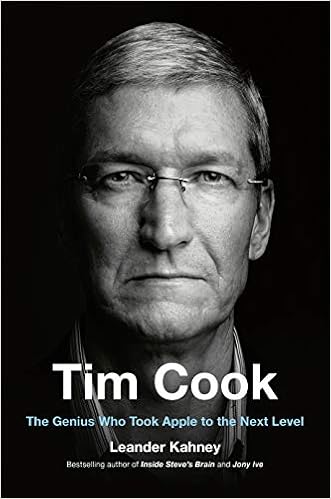
I love biographies and especially about people like Tim Cook.
As we all know, Tim Cook is a steady pair of hands and do well in STEM subjects since young.
Btw, i skipped all the parts regarding:
- sustainability
- diversity
- blah blah .... etc
- blah blah .... etc
Key takeaways from this book:
- Simplicity
- Jobs cut Apple's sprawling product line back to just four models: two desktop machines, one for ordinary consumers and the other for professionals and two portable machines.
- Work ethics
- MBA - work all day and spend 3-4 hours at night at school and assignments on top of that
- Tactics
- Tim Cook rarely raised his voice, but he was relentless in attaching a problem and could wear down people through an endless barrage of questions
- The questions helped Cook really drill down into the issue and ensure the staffers knew what they were doing. It was effective because it kept staff on their toes and on top of their responsibilities.
- He'll ask you ten questions. If you answer them right, he'll ask you ten more. If you do this for a year, he'll start asking you nine questions. Get one wrong, and he'll ask you 20 and then 30.
- Cook required incredible amounts of details from his staff. "They're nervous going into meetings with him,"
- Empowerment
- Despite this emphasis on the importance of attention to detail and solving problems, Cook trusted and empowered his staff to make decisions.
- Extra mile
- To win Cook's respect and appreciation, employees not only needed the right answer to questions at all times, they also need to show a willingness to go the extra mile.
- Marathon
- Meetings were more like marathons, an analogy made more appropriate by the fact he snacked energy bars throughout them
- Famous speech
- In business as in sports, the vast majority of victories are determined before the beginning of the game. We rarely control the timing of opportunities, but we can control our preparation.
Higher Returns From Safe Investments
Using Bonds, Stocks, and Options to Generate Lifetime Income

Summary:
This is a book that talks about safer instruments that help to generate dividend income:
- Bond - Bond basics and pros vs cons. This is pretty typical of any bond books
- Introduction about Bond Ladders - Higher interest income with less risk.
- High yield bond investment using Bond Mutual Funds.
- TIPS (Treasury Inflation Protected Securities)
- Municipal bonds - section i skip as it's not relevant to me.
- Preferred Stocks
- Equity ETFs
- Bond Mutual funds, TIPS & different types of bonds, preferred stocks
- Options
- Short term bonds yield less than long term bonds.
- Bond price has an inverse relationship with interest rate. When interest rate rises, bond prices will fall and vice versa.
Chapter 3 - Risks of Bond Investing:
- To measure risk - A drawdown is the percentage loss from a high point to a subsequent low point value of an investment
- Type of risks:
- Interest Rate Risk
- Default/Credit Risk e.g. Credit downgrade
- Inflation - interest rates move in the same broad direction as inflation
- Liquidity Risk

Chapter 4 : Bond Ladders - Higher Interest Income with Less Risk
----------------------------------------------------------------------
The Dhandho Investor: The Low-Risk Value Method to High Returns

Amazon Stars

Summary
This book is a Value Investing book or at least close to it. The concept is around this word - Dhandho (pronounced dhun-doe) which means "endeavors that create wealth". Instead of preaching the typical buy low and sell high, it started with a few success stories:
- Patel Motel Dhandho
- Buy cheap price Motel when price is depressed
- Lowest cost operator model for unassailable competitive advantage
- Use the high cashflow to buy the next motel and create the snow ball
- Manilal Dhandho
- Pool resources together from multiple sources if you don't have the necessary funds
- Motel bargain hunting during severe impact of 9/11
- Few Bets, Big Bets, Infrequent Bets
- Virgin Dhandho
- Very little money invested in any of the Richard Branson's startup
- Even if half these ventures fail or never scale, it doesn't matter. There's virtually no money put into them to begin with.
- Low Risk, High Return
- Mittal Dhandho
Key takeaways: Low Risk, High Returns. Heads, I win; tails, I don't lose much!
Chapter 5 - The Dhandho Framework
9 principles:
- Focus on buying an existing business (with well defined business model and long history of operation)
- Buy simple businesses in industries with an ultra slow rate of change
- Buy distressed business in distressed industries
- Buy businesses with a durable competitive advantage - The Moat
- Bet heavily when the odds are overwhelmingly in your favor
- Focus on arbitrage
- Buy businesses at big discounts to their underlying intrinsic value
- Look for low risk, high uncertainty business
- It's better to be a copycat than an innovator
Chapter 6 - Dhandho 101: Invest in Existing Businesses
It's basically why investing in stocks is better than buying/selling a whole business.
6 big advantages stock over businesses:
- No heavy lifting to run an entire business
- When you buy a stock, you have an ownership stake in the business which is staffed and running
- For stocks, we might be able to place an occasional bet when odds are heavily in our favor.
- Buying an entire business requires some serious capital
- You can buy stocks in a few mouse click and from thousands of publicly traded businesses in different countries
- High transaction costs for purchase price
Only invest in businesses that are simple - ones where conservative assumptions about future cash flows are easy to figure out.
Chapter 8 - Dhandho 201: Invest in Distressed Businesses in Distressed Industries
6 sources to find distressed businesses:
- Business headlines
- Value line - low P/E, 52 week low
- Portfolio Reports - 10 most recent stock purchases by top value managers
- Public filings - EDGAR or www.nasdaq.com
- Value Investors Club (www.valueinestorsclub.com)
- Read "The Little Book That Beats the Market". After reading, visit www.magicformulainvesting.com.
How do we know when a business has a hidden moat and what that moat is? The answer is usually visible from looking at its financial statements. Good businesses with good moats generate high returns on invested capital. The balance sheet tells us the amount of capital deployed in the business. The income and cash flow statements tell us how much they are earning off that capital.
The businesses mentioned earlier as having narrow or nonexistent moats—Delta, Gateway, General Motors—all had pretty formidable moats at one time. They have all eroded over time, just like the most well-defended castle eventually falls into the enemy’s hand. Here is Charlie Munger’s take on it:
Of the fifty most important stocks on the NYSE in 1911,
today only one, General Electric, remains in business. . . .
That’s how powerful the forces of competitive destruction
are. Over the very long term, history shows that the
chances of any business surviving in a manner agreeable
to a company’s owners are slim at best.1
—Charlie Munger
This chapter talks more on Kelly Formula. Assume you’re offered a coin toss where heads means you get $2 and tails costs you $1. How much of your bankroll should you bet if you’re offered these odds?
According to Kelly Formula, the edge is [(0.5 x $2) + (0.5 x -$1)] = $0.50. $0.5/$2 = 25%. Kelly Formula suggests you bet 25 percent each time. Using the Kelly Formula may lead to relatively high volatility. The formula optimizes just one variable—the maximization of wealth in the least amount of time. It is agnostic on volatility.
A few areas to arbitrage:
· Traditional commodity arbitrage
· Correlated stock arbitrage
· Merger arbitrage
· Dhandho arbitrage
The Intelligent Investor is still the best book on investing.
It has the only three ideas you really need:
1) Chapter 8—The Mr. Market analogy. Make the
stock market serve you. The C section of the Wall
Street Journal is my business broker—it quotes me
prices every day that I can take or leave, and there
are no called strikes.
2) A stock is a piece of a business. Never forget that
you are buying a business which has an underlying
value based on how much cash goes in and out.
3) Chapter 20—Margin of Safety. Make sure that
you are buying a business for way less than you
think it is conservatively worth.2
—Warren Buffett
Key takeaways:
1. The bigger the discount to intrinsic value, the lower the risk.
2. The bigger the discount to intrinsic value, the higher the return.
Here are a few scenarios that are likely to lead to a depressed stock price:
High risk, low uncertainty
High risk, high uncertainty
Low risk, high uncertainty
The fourth logical combination, low risk and low uncertainty, is loved by Wall Street, and stock prices of these securities sport some of the highest trading multiples. Avoid investing in these businesses. Of the three, the only one of interest to us connoisseurs of the fine art of Dhandho is the low-risk, high-uncertainty combination, which gives us our most sought after coin-toss odds.
Case studies discussed:
McDonald's
Microsoft
etc
Chapter 15 - Abhimanyu's Dilemma: The Art of Selling
To be a good investor, we need a robust framework for both the buying and selling of stocks.
Seven questions that an investor ought to be thinking about before entering any stock market :
1. Is it a business I understand very well—squarely within my circle of competence?
2. Do I know the intrinsic value of the business today and, with a high degree of confidence, how it is likely to change over the next few years?
3. Is the business priced at a large discount to its intrinsic value today and in two to three years? Over 50 percent?
4. Would I be willing to invest a large part of my net worth into this business?
5. Is the downside minimal?
6. Does the business have a moat?
7. Is it run by able and honest managers?
A critical rule of chakravyuh traversal is that any stock that you buy cannot be sold at a loss within two to three years of buying it unless you can say with a high degree of certainty that current intrinsic value is less than the current price the market is offering.
As a corollary, the only time a stock can be sold at a loss within two to three years of buying it is when both of the following conditions are satisfied:
1. We are able to estimate its present and future intrinsic value, two to three years out, with a very high degree of certainty.
2. The price offered is higher than present or future estimated intrinsic value.
The key to being a successful investor is to buy assets consistently below what they are worth and to fixate on absolutely minimizing permanent realized losses.
The three-year rule also allows us to exit a position where we are simply wrong on our perception of intrinsic value. If we didn’t have an out and always waited for convergence to intrinsic value, we may have an endless wait. There is a very real cost for waiting. It is the opportunity cost of investing those assets elsewhere. Hence, there is a balance between allowing a sufficient time frame for a stock to find its intrinsic value and waiting endlessly.
Chapter 17 - Arjuna's Focus: Investing Lessons from a Great Warrior
The Dhandho investor only invests in simple, well understood businesses. That requirement alone likely eliminates 99 percent of possible investment alternatives. Now, like Arjuna, we must be down to only reading up on simple, well-understood businesses. We must remain squarely in our circle of competence and not even be aware of all the noise outside the circle. Within the circle, read pertinent books, publications, company reports, industry periodicals, and so on. Every once in a while something about a business will jump out at you. If there appears to be some meat on the bone and you sense that the business might be underpriced compared to its intrinsic value, it is time to hone
in. At that point, you need to become ultra-focused like Arjuna. All you should see is this one business. Shut everything else out. Nothing else exists on the planet. Drill down and see if it truly is an exceptional investment opportunity.
Ask yourself if it fits in as a Dhandho buy. Most times it won’t be as cheap as you’d like or something will bother you and you’ll take a pass. In that case, go back to scanning the radar within your narrow circle. Again, when something jumps out, focus intently on it until it’s either rejected
as an investment or passes all the Dhandho filters and you make the investment.
Do not make the fatal mistake of looking at five businesses at once. Learn all you can about the business that jumps out for whatever reason and fixate solely on it. Once you’re at the finish line with your analysis, only then look at the broader circle of competence.
--------------------------------------------------------------------------------------------------------------------------
The 52 Week Low Formula
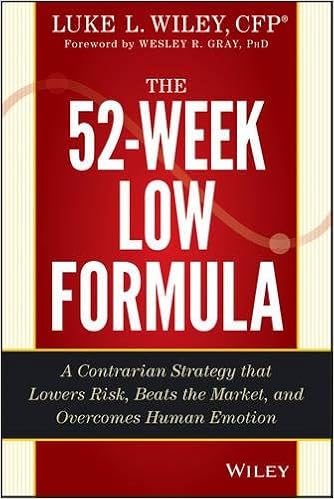
Filter 1: Durable Competitive Advantage
- Is the company in an industry with good economics?
- Are revenues dictated by customers or vendors?
- Is it a saturated industry in which the company is easily replaceable?
- Has the company demonstrated a consistency of generating returns on capital over its cost of capital over a full business cycle?
- Does the company appear to have an economic moat that will allow it to fend off competition?
Filter 2: Free Cash Flow Yield
- Does the company create free cash flow sufficient to allow for cash distribution and/or reinvestment while maintaining its competitiveness in the marketplace?
- Does it have not only positive free cash flow, but enough of a margin of safety or opportunity for excess cash flow over the risk-free rate to justify the investment risk?
Filter 3: Return On Invested Capital
- Does the company invest money in such a way that it generates returns on capital above its cost of capital in the current environment?
Filter 4: Long Term Debt to Free Cash Flow Ratio
- If something catastrophic happens, can the company services its debts and maintain its production capacity?
- Can the company pay off its long-term debt with its free cash flow within 3 years

No comments:
Post a Comment